

THREAD Selection
Not 'string' but THREAD!
I get such a kick out of amost EVERY sewing student I have (child AND adult) call thread ‘string’ - instead of thread. My response? “We fly a kite with STRING. We sew fabric with THREAD.”
I have NO doubt that my ‘career’ in being a fabric/machine store owner served to educate me about sewing thread in a way that I would never have realized without these experiences!
NOTE: What I share below comes from my experience with garment sewing with home sewing machines (not industrial). I truly have no experience with industrial strength (and speed) machines, so please - if you have industrial machine info - feel free to share your knowledge by Commenting to this post.
BOTTOM LINE: Choose a thread that is the same weight (diameter) as the ‘threads’ of which the fabric is made. Lightweight, thin fabric needs finer thread. Heavier weight fabric needs heavier thread. Just keep that in mind. AND… if the fabric stretches, SO must the thread!
AND… never use a thread that is stronger than the fabric of which the garment is made. Honestly, if there is stress on a seam, it is better that the thread break than the fabric tear away from the seam; as one can always re-stitch a seam, but if fabric has torn away from the thread in a seam, it may well make a garment too small to take it in to ‘mend’ the rip of the fabric.
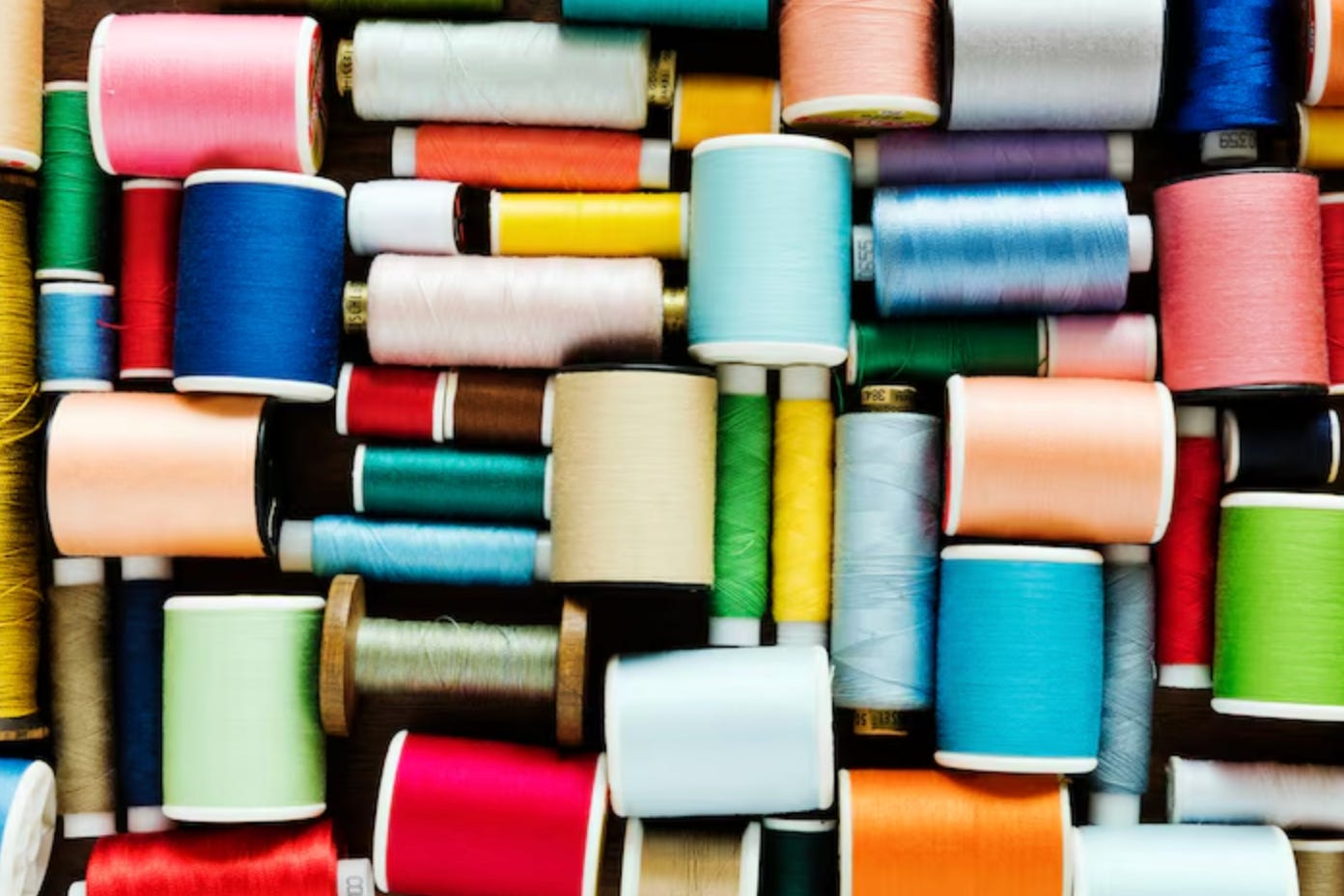
Understanding Sewing Thread: Fiber and Weight
When choosing thread for your sewing projects, there are two main aspects to consider: fiber (what the thread is made from) and weight (how thick or thin it is).
Fiber: The Material Makeup
Fiber is the easier of the two to understand and identify. Thread can be made from a single type of fiber or a blend of different ones. Some of the most common options include:
Cotton: Thanks to the huge popularity of quilting over the past 35 years, cotton thread has become a go-to choice for many sewists. One simple way to test if a thread is cotton is to pull it firmly - if it snaps cleanly, it’s likely cotton. Polyester thread, by contrast, tends to stretch before breaking. Much ‘old’ thread is cotton - especially if on a wooden spool. It is likely brittle, so ‘re-hydrate’ by soaking in a pan of water, submerged. Then… put it in the refrigerator for a few days. It’s worth a try anyway - and I was told this ‘trick’ by a thread manufacturing President.
Other common fibers include polyester, silk, nylon, and rayon, each with its own strengths (like durability, sheen, or elasticity), but cotton remains especially beloved in quilting and traditional sewing.
Weight: Thickness and Numbering Systems
Thread weight refers to its thickness or diameter. Unfortunately, there’s no universal sizing standard across all thread manufacturers, so a “50-weight” thread from one brand might not be identical to a 50-weight from another.
What is consistent, however, is the numbering logic within the same brand:
The higher the number, the finer (thinner) the thread.
For example, with Mettler cotton threads (a brand I carried in my fabric shop and highly recommend):
60 wt: Very fine - perfect for heirloom sewing, delicate laces, hemstitching, or appliqué where you want the thread to nearly disappear. A notation on a spool would be 60/2 which designates 60 wt, and 2 ply (2 ‘ply’s twisted together to make the thread.)
I even carried 80 wt cotton thread - in white and ecru, for VERY FINEST Thread - perfect for heirloom lace work, especially hemstitching, as the fine thread didn’t fill up the hole from the wing needle! Madeira was the brand for that thread. I also remember ‘Tanne 80’ - I believe I got from Martha Pullen Company way back then.
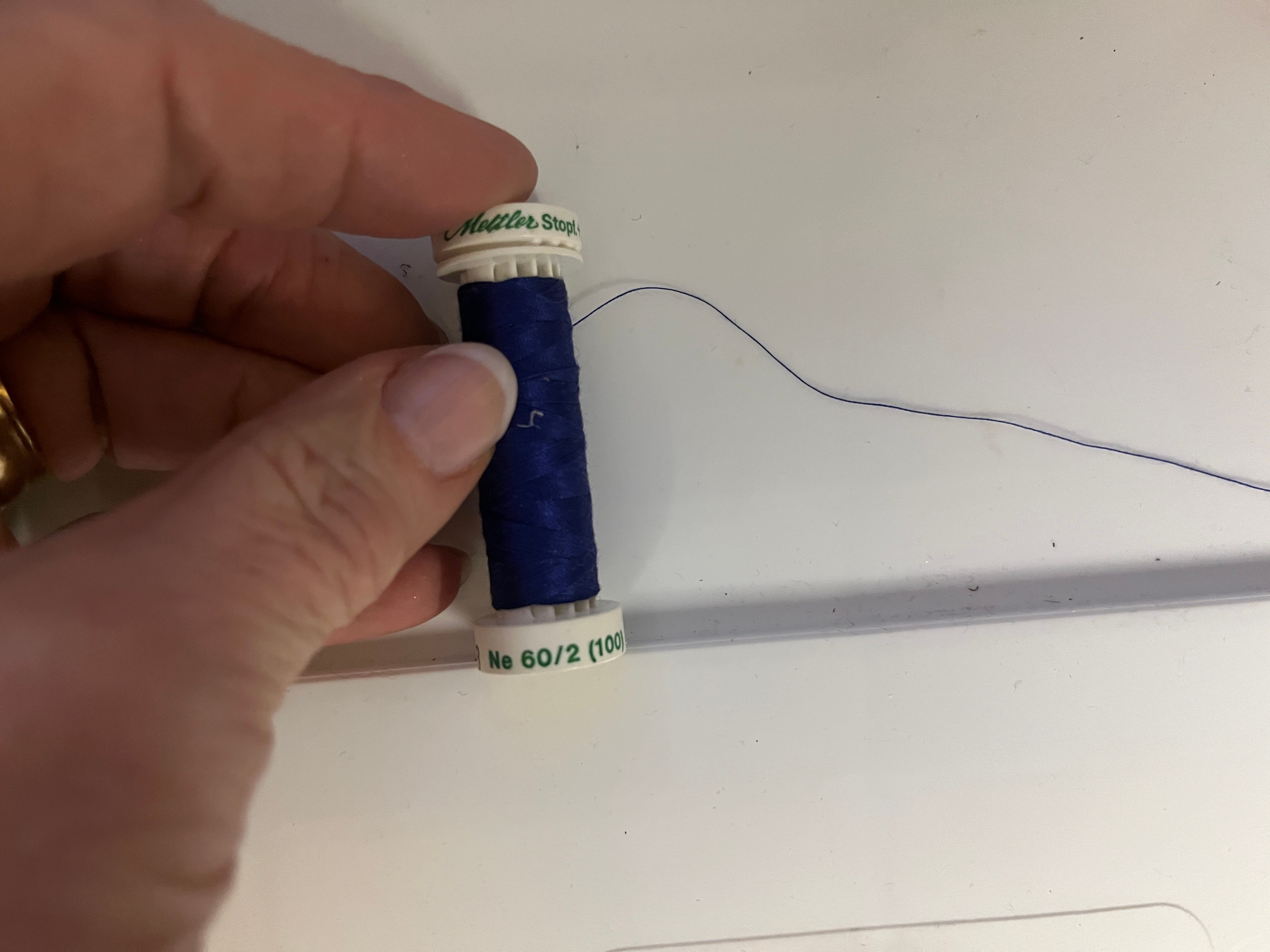
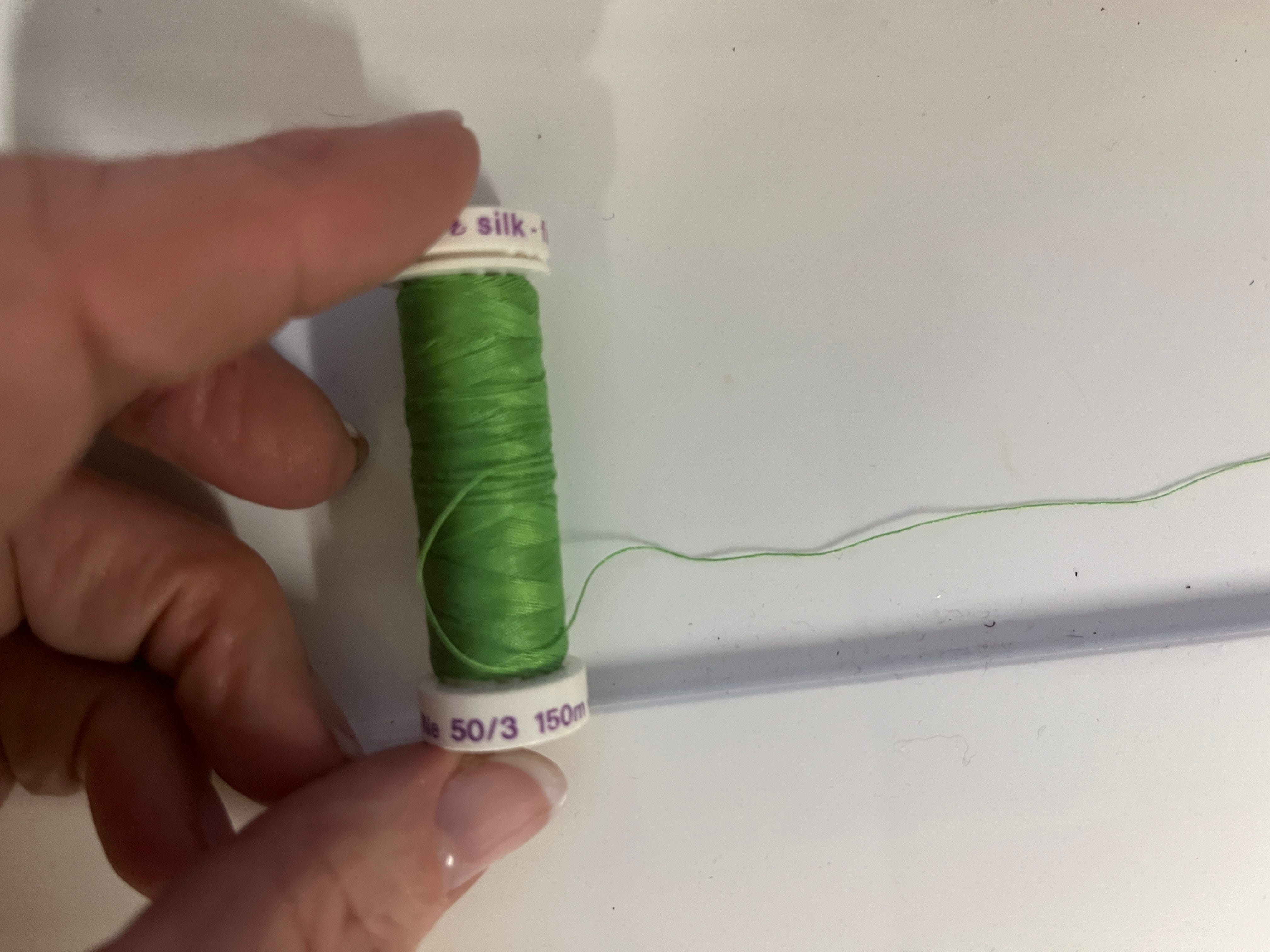
50 wt: The ‘standard’ all-purpose weight, widely recommended for piecing quilts and general garment construction.
30 wt: Heavier and bolder - ideal for machine embroidery, topstitching, or decorative stitches, as it beautifully fills in buttonholes and ornate designs.
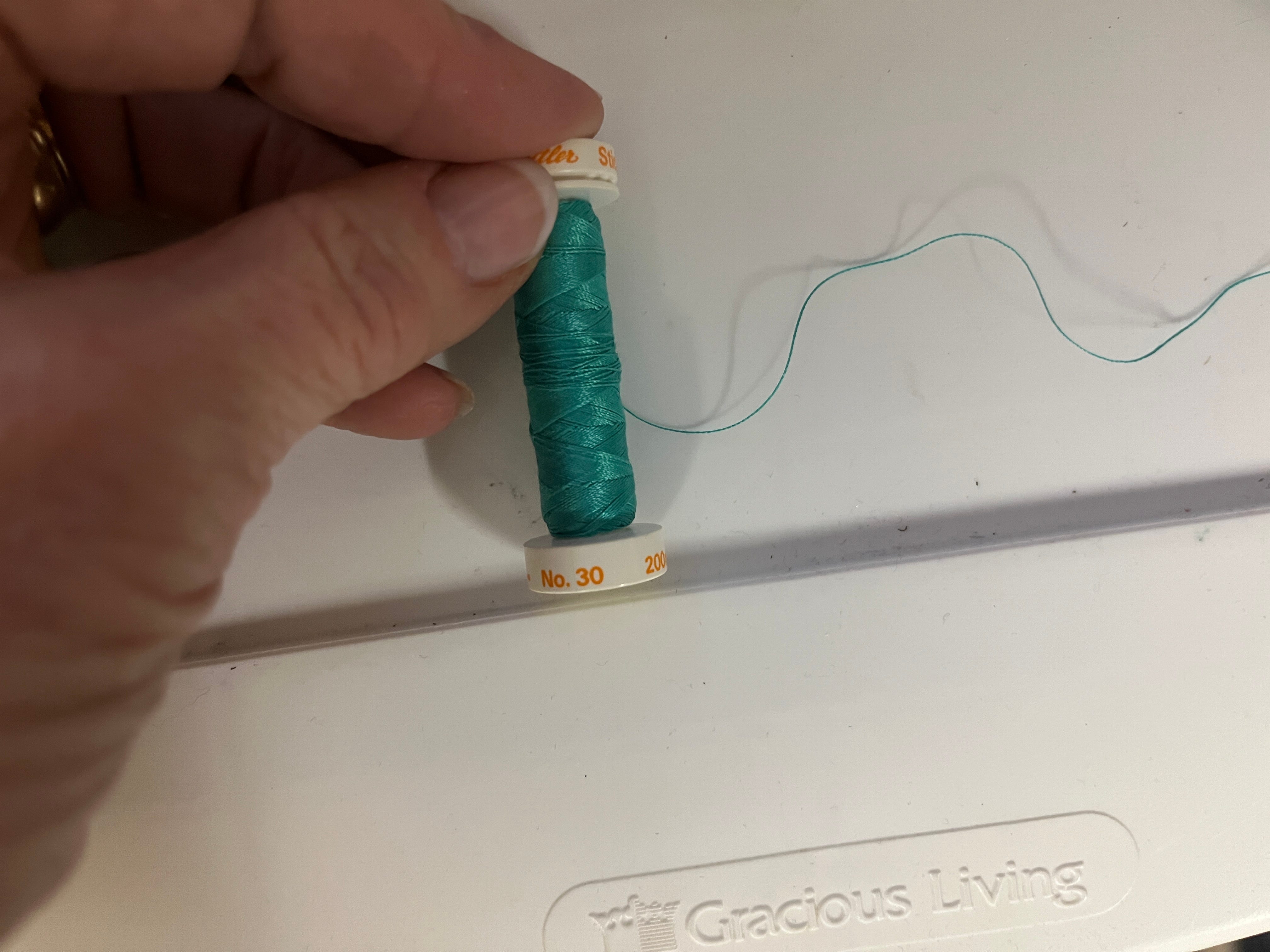
As a former sewing machine dealer, we were told by machine manufacturers to always keep our demo machines threaded with 30 wt cotton because it made decorative stitches and buttonholes look full and impressive right out of the box.
By paying attention to both the fiber and the weight, you’ll be able to select the perfect thread for your project - whether you need something strong and subtle for piecing or thick and vibrant for embellishment.
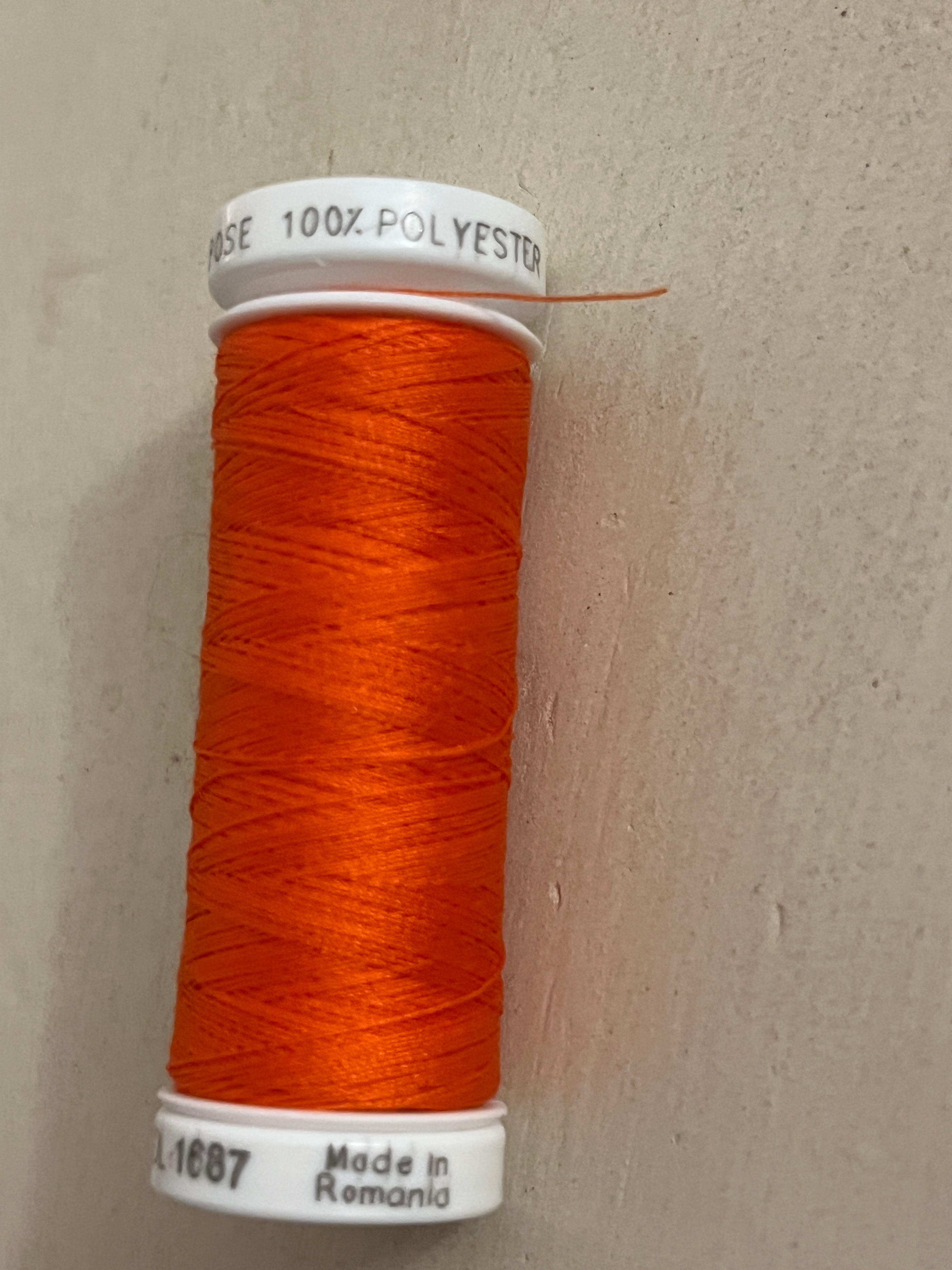
POLYESTER - for sewing on knit fabrics. Polyester thread stretches, and is stronger than cotton thread. Honestly, in my Studio, I’ve moved to a vast majority of polyester thread as my ‘default’ because so many garments made are of knit fabric. Even for craft-type sewing, the strength of polyester is ideal - and now that JoAnn Fabrics is gone, I am buying my thread at Hobby Lobby - a good polyester thread that they sell at discount of $1.99/spool which is a good price! The ‘brand’ is Sew-Ology, and so far I have been quite happy with it - and for sure, with the price! On the spool - says made in Romania. See image below. Gutermann Thread is also excellent in my opinion - and looking at the behemoth: Amazon, there are many choices there. Also good choices: Superior Threads - and YLI. I’ve used and had good luck with all of these. Talon and Coats n’ Clark cotton wrapped polyester - Nah, I’d personally not choose to sew with either of them. My experience talking, and yours may be different …
Cone thread as used on sergers is generally polyester, as the tensile strength needed in a serger requires a strong thread…hence polyester (or nylon as in ‘Wooly Nylon’. If a dark, especially black cone thread keeps breaking on you - it is likely ‘over-dyed’: meaning it was a bad dye lot from some other color that then they just over-dyed to black…or so I was told by a sewing educator from one of the machine companies I represented. I have no idea if that is really true or not.
SILK - can be heavy - like buttonhole twist, or ‘regular’ weight, a very fine thread. Obviously, it is ideal for lightweight silk fabrics. For hand sewing, there is no more better way to treat yourself, than to sew with silk thread, as it floats through the fabric like butter! Clover Notions has Tire Silk Thread - available from Amazon.
COTTON-WRAPPED POLYESTER
personally, I hate this thread. Coats n’ Clark is the main manufacgturer of this thread. It twists and knots when used in hand sewing something terrible - at least that is my experience. The explanation I was given by the president of Superior Threads at a sewing machine convention is that it was developed to ‘look like cotton’, but have the stretch of polyester as needed for knits. I learned SEW MUCH in that one class from that man that helped me IMMENSELY in my sewing career: both as a shop owner and in my personal sewing.
OTHER THREADS
More for either decorative needs as in machine embroidery, or very utility-focused, as needed for upholstery or canvas type fabrics INCLUDE:
Nylon is the main fiber - known for strength, so it is often used in upholstery and for cushions that are outside - like on patio furniture. Nylon can also be super thin, as in an invisible monofilament thread (which I use quite often). ‘Wooly nylon’ is a fibrous, ‘fuzzy thread used in the loopers of sergers to ‘fill in’ as on a rolled hem edge. The other invisible monofilament thread is polyester.
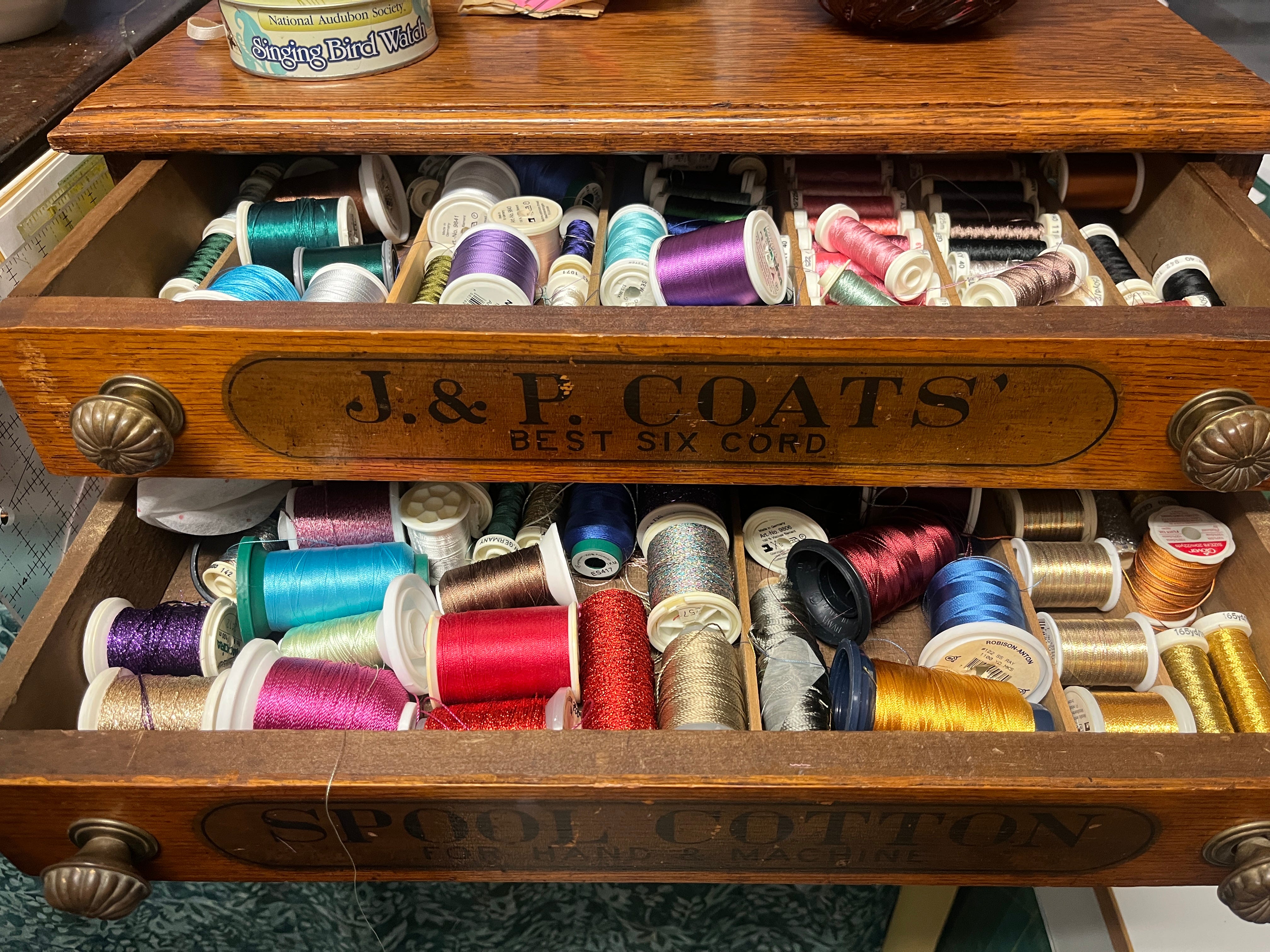
DECORATIVE THREADS
Here’s my ‘collection’ in this valued antique thread cabinet - which I covet!
RAYON is the first that comes to mind. During my shop days, when machine filled-in embroidery was just ‘coming on’, the main thread brands were Madeira and Sulky - both rayon. Polyester has won out over rayon due to it’s strength and color-fastness for that type of embroidery.
Rayon decorative threads were also ‘big’ back in the 90’s when I had my storefront - especially in decorative serger threads which were put into the upper and lower loopers of a serger to create ‘stand out’ edges.


METALLIC threads also ‘exist’, and - bottom line - are a challenge across the board in my opinion and experience. Different ‘lubricants’ (Needle Lube) exist to reduce friction and are meant to help metallic threads ‘work’ in machines.
A WORD ABOUT COLOR SELECTION:
Always select a color that is darker than the background of the fabric to be sewn! Honestly - it will ‘sew in’ much, much better - and be seen less.
For New Sewers; dark colors and printed fabrics hide a vast majority of not-so-perfect stitching that would be quite obvious on lighter colors and solid fabrics! Read that AGAIN! Even on The Great British Sewing Bee, I see this TRUTH - often! BTW - I LOVE that show!!!! You can find it on ROKU.
This video I taped will help explain even more about thread.
ORGANIZING THREAD
My ‘organization’ is not very high-tech, but rather just in clear large ziploc threads based upon color ‘family’. Occasionally, it ‘gets to me’, and I sit and clean it out, properly catching the ends of the threads on the spool cap a shown below.


I’m hard at work on my Deep Dive into several Upcycled garments for my upcoming Feb. 26 SKOOL Class. While you can still subscribe for FREE, doing so will only give you accessibility to my January 29 class: Foundations of Upcycle Sewing. Future learning is for paid students only: $9/month or $90/year. You decide - but for $9/month, I promise you LOTS of learning - recorded the 4th Thursday 7 pm CST each month (you can attend live), and then have access to the classes at any time that is convenient for you. Just click on the button below to learn more and join in with the fun!
Thanks for the very informative article. I found it to be helpful...